Concert series taking place on Prince Edward Island
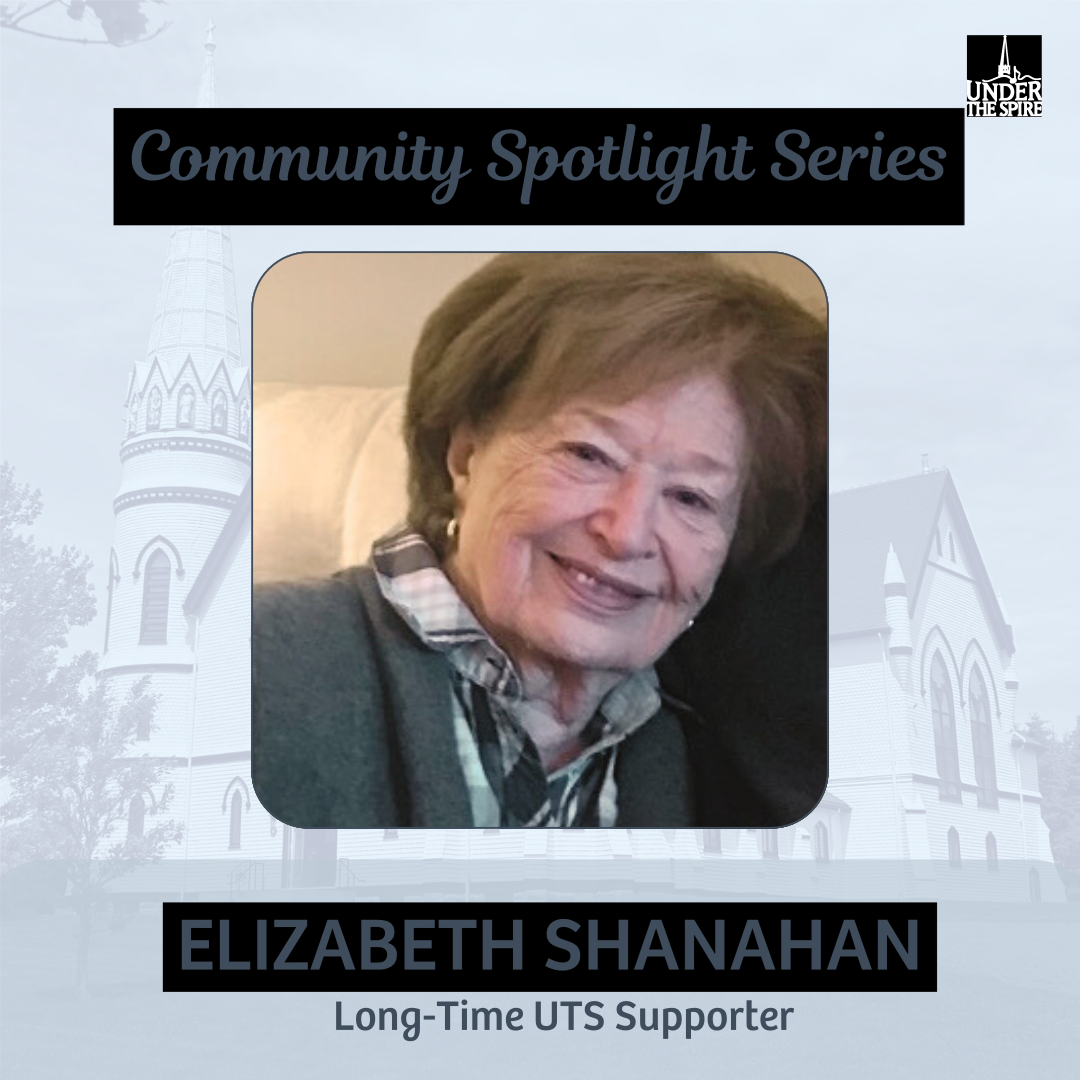
Community Spotlight Series: Elizabeth
As we celebrate our 30th anniversary in 2025, we’re excited to reflect on the vibrant stories and community members who have helped shape Under the Spire’s story. Our Community Spotlight Series will feature a diverse group of supporters, sharing their personal connections, experiences, and favorite memories with us across 10 interviews. Through their testimonials, we’ll explore why Under the Spire holds a special place in their lives and in our community. We are deeply grateful to everyone who has contributed to this celebration by sharing their reflections with us!
Community Spotlight Series
Interview with Elizabeth Shanahan
1. How did you come to know about UTS, and how did you become involved with the organization?
I’m from PEI originally. In 1996 my father passed away, so we went back to PEI for the summer and spent the whole summer there. 1996 was the year when the concert series as we know it now began. We went to a couple of concerts that summer and it was great – it just added another component to our summer experience. I remember seeing Richard Kapp and Mela Tenenbaum – they were from New York, and the following year they brought in another New York couple, a pianist Mescal Wilson and a cellist John Kneiling. Those were the very, very first concerts I remember. In the early days, 1998 or 1999, Adrian Hoffman was a CBC radio personality. He was head of classical music for Atlantic Canada – CBC was doing these programs regionally. CBC started taping a number of our concerts every summer, and this went on for at least six years. Sometimes they would come more than once during the summer. During those years, they always attended Midsummer Magic. In those days, Midsummer Magic ran for four nights – Thursday, Friday, Saturday, and Sunday – and the CBC crew pulled in with their van and with all their recording equipment. They would come on a Monday afternoon and get themselves set up. . . [these recordings] helped result in getting big names because we got some money from CBC and we got national exposure. These were the days when we could get all the top Canadian classical and opera singers on the stage, and they would come for the weekend and they would participate in a couple of the four concerts. And so it was during these years also that artistic director Robert Kortgaard brought in a national CBC radio music personality to be the host during the master of ceremony for the concert. He brought in and these names like Eric Friesen – Eric had a national evening, Monday to Friday, classical music program on CBC.
I used to go and sit in the rehearsals all the time. I found them more interesting than the concert itself. And the acoustics and sound in the empty church was different than when it was full – so that was a wonderful little perk. Anybody could go and listen, but not many did, but I was there all the time. I loved it. We would bring in all of these musicians and we’re asking “Where are we going to put them?” So that started a hosting or billeting program. . . it developed into quite a lot of after-concert festive frolics because these artists don’t tend to eat very much before they perform, so they were hungry after the concerts.We started having these post concert gatherings and feeding them. That developed into a real social group of people that hung around with the artists after the concert and got to know them and that was special.
What kind of things were you helping out with at the concert series?
Whatever was needed. I had been involved with this sort of thing in other places that we had lived, and felt it would be beneficial if we were able to have activities that would cement both our benefactor and patron base. They would feel part of the festival and they would buy into it. In 1998, we hosted a small reception after a concert. It was unofficial – we knew some of the people involved and I think we did about the same thing the next year – by 1999 or 2000, the receptions became an official part of the festival. After opening night, there would be a reception which included whatever artists, our benefactors, patrons, government people, corporate donors. . . that sort of thing. There would be a reception following the concert with around 60 people who would come after the concert where reception was being held. We were able to form a hospitality committee, so there were half a dozen people that helped do this and helped prepare the food or whatever needed to be done.
2. What does Under the Spire mean to you? How has your time with the organization shaped this?
It was the music, and it was the friendships we made with the people who were involved. We were the type of summer people that would spend all our time on the beach or on the golf course. This added a dimension to our summers that we had not counted on, but made them wonderful. I had been involved with both the Toronto Symphony Youth Orchestra as a volunteer, and with the Montreal Symphony. So this was just carried on from my interest in volunteering in the music field. It was almost a seamless transition for me. It made our life on PEI in the summertime. If not for the festival, this would not have happened. Even though I’m from PEI and have family connections and all high school friends, the circle wasn’t big because I’d been away for so long. It was great – the people that were associated with the festival were wonderful, dedicated people.
3. How has your time at UTS influenced your views on the importance of arts and culture? Why might it be important to support as a community member?
Well, from early days my parents exposed me to music. And then I lived in Halifax for a while and I was on the board of the Nova Scotia Festival – I was on because of my job, but I found I really loved it. I think that was my first foot in the door. I remember Maureen Forrester – the first concert that I was involved with, she was the opening act and she was Canada’s contralto of the day and had a big big career. I was in my 20s and I think that really gave me the bug. We carried on from there, and wherever we lived I think I gravitated again towards getting involved as a volunteer with the arts, looking for those different opportunities wherever you can find them. I think that [the amount of local people at the concert series] has developed nicely. I think a lot of local people thought it wasn’t for them, especially the classical side. . . We had neighbors that had never been to an opera or classical performance. Then, after they went the first time, they were smitten and they came to all the classical and opera programs after that. I think the festival has done a lot to jump over the hurdles so that the people – islanders – have bought into it now.
4. Drawing from your own experiences, do you believe that people should take interest in supporting live music and music initiatives within their communities?
Yes. Unless you have support, classical music will not survive. There’s a struggle in a lot of places with classical music and it’s a fight to keep it vibrant and to be able to continue with the programming because everything is so expensive.
On a side, how nice it is to have had all of the singers come through the concert series that we’ve had! The opera here a couple of weeks ago in Calgary brought in Midori Marsh. She was one of the leading lights! One of the nice things about what we were exposed to through the concert series was the fact that we heard all these singers in Indian River and now we’re hearing them in other places – New York, Calgary, Toronto, Montreal. Even in Vienna, we heard soprano Adrianne Pieczonka and she’d performed at the concert series before. It’s interesting, the people who were at the concert series and are on the national and the international stage.
5. Can you share some special memories that you have from your time at UTS?
I think a lot of good things have melded together into one big thing – that it was marvelous. I think as far as walking into the church, the rehearsal with Measha Brueggergosman and The Jive Kings was the first experience I had of someone really blasting out in the space. The other one was Jane Archibald. She probably had the most powerful voice of anybody that performed in that space. She’s an international opera singer from Truro, Nova Scotia who married a college friend of mine. She went on to have an international career singing at the Met and singing a lot in Germany, in fact she’s in Germany right now with Opera Berlin!
Another highlight of the early days was the National Youth Orchestra performance. That was a big deal. Measha Brueggergosman sang with them and it was great. That was probably the biggest house we ever had! They had chairs up the aisle in the center, up the side on the edges of the five pews. You could hardly get through. So that must have been over 500 people there. We had a few of what I would say are full houses in those days, but this one was beyond full. You couldn’t get through – it was crazy. Of course, with the National Youth Orchestra, there were so many of them – they were all over the stage and they were up in those little side steps and then there were a few down on the steps. I mean, there were just about 110 people up there. That was the biggest deal we ever did.
Another one – I mean, there’s just so many. A choir came from Cambridge University in England, over 40 of them. They toured the maritimes and they presented at our concert series and they were billeted around the community. The hospitality committee had a barbecue for them the night they were to perform. This is a funny little story – Rene Hurtubise, one of the former chairs, is a marvellous cook. I knew he was a wonderful cook, so I presumed he barbecued. So we have a bus arrive, 42 people get off, and Rene is there and the barbecue is all set up. My husband is away travelling, and so I said ‘Rene do the barbecue. We’re going to eat. You’re going to have to barbecue.’ Then he said ‘Oh, I don’t barbecue.’ 42 people are coming – who is going to cook the meat? I look out and the bus driver is crossing the garden to come up to the door. I said to him, ‘Do you barbecue?’ He said ‘I do.’ I said, ‘You’re barbecuing for all this.’ And he did. That choir was pretty exciting – all these young people – they were great.
We hope you enjoyed reading Elizabeth’s interview! Be sure to read the rest of the interviews from this series