Concert series taking place on Prince Edward Island
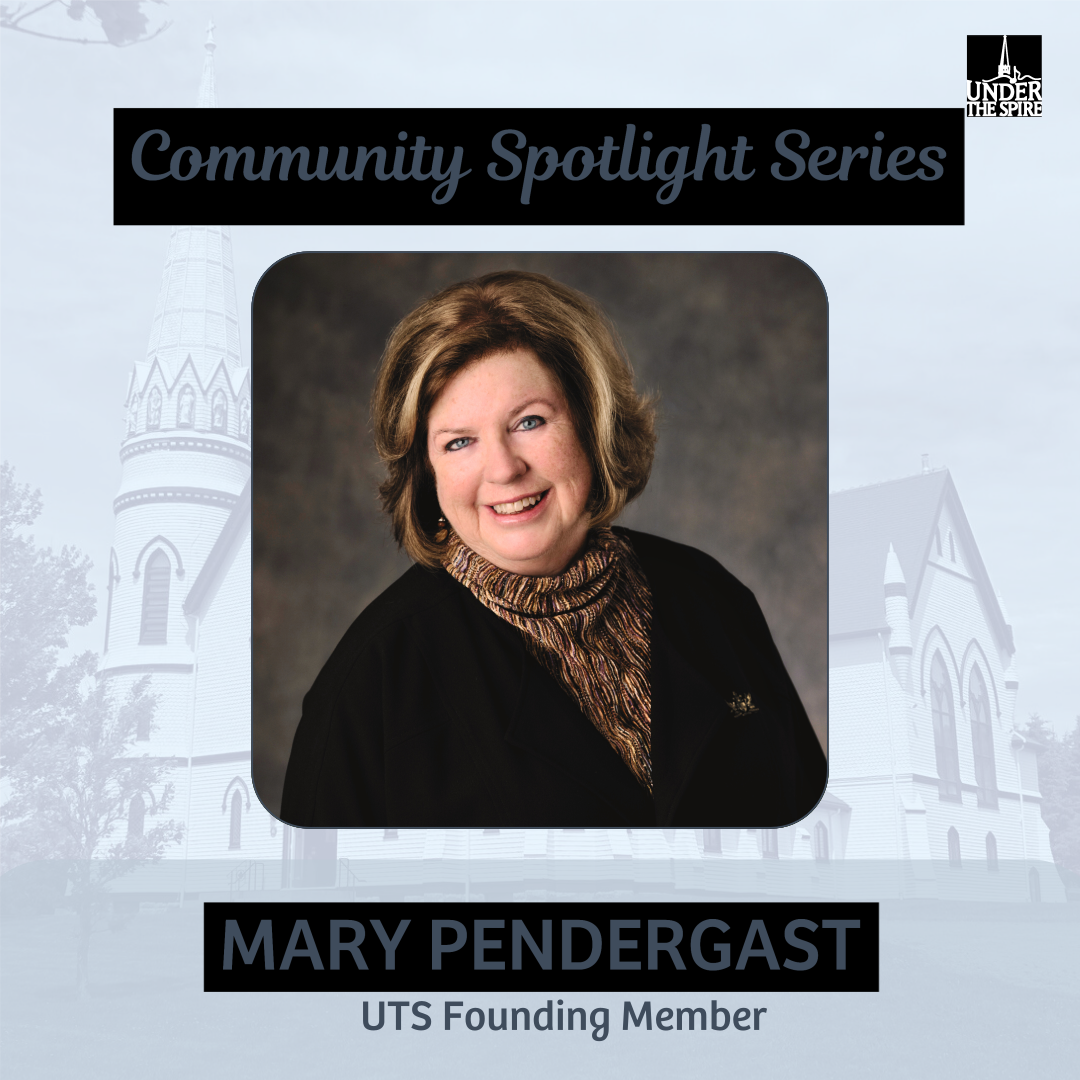
Community Spotlight Series: Mary
As we celebrate our 30th anniversary in 2025, we’re excited to reflect on the vibrant stories and community members who have helped shape Under the Spire’s story. Our Community Spotlight Series will feature a diverse group of supporters, sharing their personal connections, experiences, and favourite memories with us across 10 interviews. Through their testimonials, we’ll explore why Under the Spire holds a special place in their lives and in our community. We are deeply grateful to everyone who has contributed to this celebration by sharing their reflections with us!
Community Spotlight Series
Interview with Mary Pendergast
1. How did you come to be involved with the music at Historic St. Mary’s, and how did you help advance the organization?
I was part of the parish, and grew up in this area. We used the church year-round as I was growing up. As it got a little bit more and more in disrepair, we stopped using it in the winter time and made use of the smaller wintertime chapel. In the mid 80s, there was a sort of a decision that the parish had to make. “Are we going to abandon the building or are we going to buckle down and raise the funds?” There were some really key people at the time who said, “No, we’ll raise the funds.” We had a fundraising campaign, “Save St. Mary’s” it was called, which worked out pretty well. In about 1987, we had part of the fundraising campaign that kind of sold off everything. You could have an apostle up on the spire for $2500, to name each one of the pews was about $150. So we did that, and my role was that I was on the committee to arrange a supporting concert series. So that’s when that started – in 1987, with a concert series called “Sundays in the Summer.” And it just kind of kept – everybody loved it. The music was really beautiful in the church and it was a great way to have everybody welcomed in and enjoy the music. And it was the first summer for that in 1987 which went well, there were many positive things about it. It did not make a ton of money, as part of the fundraising it was much more of a way for people to come in and enjoy the building and hear great music. I think it really laid the foundation for the importance of maintaining the building. You can’t let something so well crafted, so beautiful and everything just fall into the ground in disrepair. I think we had laid the foundation with the “Sundays and the Summer” concerts until 1995, when we registered as a nonprofit.
On another note, CBC played an important role in the development of the organization. When Northumberland Brass was there, they wanted to play brass in the church. (One of the members) had arranged for CBC to come and record and so that’s when CBC first came over, which was about 1989. CBC was coming for them, but if they were coming for them, they would like to record another concert, too. That’s what we kind of developed into having CBC recording regularly. In the summer of 1995, pianist Richard Kapp came and was vacationing here, and so was Mela Tenenbaum, who plays the violin. Richard was the conductor of Philharmonia Virtuosi. CBC wanted to record them, so they did a recording in the fall of 1995. They were the ones that said, “This would be a really ideal place for a summer festival of classical music because the building itself is really excellent for classical music.” I was at the point where managing the concert series was becoming too much. I was back full-time teaching, I had four children – I was like, “This has to change. I can’t do it all myself.” And so I said, “I really liked the idea that if we’re going to do something, it’s going to be a separate entity from me just doing it for the parish.” I was up for the idea at the time I was just a little daunted. Anyway, and of course they’re Americans (Richard and Mela), so that was the different thing too. With CBC’s recordings, they have to record mainly Canadian music – they can record some American music, but they can’t be all American. So that was kind of difficult to maneuver, but we did and Adrian Hoffmann – the CBC producer of the recordings – he did the recording and he was great. He was really great at kind of encouraging people to come and then, of course, with CBC playing the music all the time, also helped to gain an audience which is really good.
That was how we formed it up. I remember Richard Kapp came up from New York City to talk to people from the community. We had the meeting in the train station because it wasn’t a pub at that time. So, we ended up forming an ad hoc committee – myself, Elizabeth Hubley, Heather Mountain, who was part of the Kensington Area Development Corporation, and Katie Baker. So we organized and hired our first executive director, and she did the application for the organization’s charitable tax status and put together the program for the summer. We started off continuing with the Sundays in the Summer series, but added the first Midsummer Magic event, which was the first week of August in 1996. Richard Kapp remained as the artistic director for the next two years, 1997 and 1998, and then it wasn’t a great fit anymore. It was Adrian that suggested Robert Kortgaard as the next artistic director. I remember meeting Robert in January of 1999 in Halifax for coffee, and we hit it right off! And so he said yes and came on as artistic director in 1999 and then it was just the next summer, 2000, that it just seemed to kind of explode. So that 5th year as a concert series, 2000, that was really a pivotal year. 2001 also seemed to gain more audience and more awareness.
Around that time, I was really busy in my personal life, and then in 2004, I was running for Parliament – so there was just like a lot happening. I stepped back from the concert series in 2004. I was always involved in the periphery, though. Looking ahead to 2009, with my contacts in government and everything I was able to help with arranging for the purchase of the building by the festival. I came back in 2013. I was always kind of involved in the periphery, so that’s the story. Then I got onto the governing and nominating committee because they were sort of having trouble finding people to get on the board of directors at that time. I think the board has become really diverse in perspectives and all of that kind of thing. I was informed of the first board and I was chair of the board pretty much over the next number of years.
We were named in the spring of 2007, as the Best Small Classical Music Festival in Canada by the Globe and Mail, and I was thinking, “Oh, that’s quite an accomplishment from 1987 when it started the Sundays in the Summer concert series to 2007 to be named Best Small Classical Music Festival in Canada from little Kensington in PEI.” And it happened another time, I think in 2015, the second time it was named their Best Small Classical Music Festival in Canada by the Globe and Mail.
2. Before your work with the concert series at UTS, did you have any previous experience in the arts community?
I had experience producing plays and doing stuff like that. In 2009, I was on the board of the Watermark Theater and was chair of that board for a few years – until 2015, I think. I really enjoyed the theater and music and all that kind of stuff. I also did the choir at church. I’ve just done a lot of event organization – so I was kind of an obvious person to say “I’ll organize the concerts in the summer” and so that’s why I took that on. It was easy for me to do, but I’m not overly musical. I love the music – I really like hearing it. And what better motivation than to have the best classical music in Canada, just outside my door? So it was some motivation to develop it that first summer in 1987. Incorporating in 1995 was another big “Woo, okay, we can do this, we can do this.”
3. How has your time at UTS influenced your views on the importance of arts and culture?
I think that kind of evolved in part because my dad was always the one who said “That church is really built for music and acoustics.” As the concerts were happening, like the Summerside Community Choir, it was really really striking how much better things sounded there. As it evolved over the years and as we built the concert series, the first five years from 1996-2001 were really pivotal years because we were saying, “Okay, this can be really effective and bring people to rural PEI and that is really a big accomplishment.” It became a destination event, which it still is. People would come from Halifax, from Moncton, from all over. Your question, “Did it shape my views of the arts and cultural world?” . . . I think it changed my realization. It made me realize after a few years how effective it is and how much it can bring to the rural areas. You know, people would come to Indian River from Summerside, Charlottetown and around, which they weren’t going to do unless there was something there to be doing. So I think it helped me realize how important it is for the rural areas to have that. and then how important it is for people who are in the urban areas to come and experience something in a rural area. It’s really important that it be authentic. And I really felt that from the beginning, it has to be authentic and real.
4. Can you speak to the impact that this concert series has had on the community in your time there?
I saw a book about PEI that was published sometime in the 80s, I don’t know exactly when it was. It was a nice book, and they had some nice pictures in it – and it had an aerial picture of Historic St Mary’s and the house beside it. And it said in the caption, “a rural church near Kensington PEI” That was before we started the whole restoration project and the music festival and all the rest of it. Now, they wouldn’t just say “an old rural church in PEI.”I mean I think it really highlighted the significance of the architecture and the acoustic design and that kind of thing that had not been done before. People knew, we kind of knew, but not to the extent of how important it was and how significant it was to actually maintain and treasure that.
5. Can you share some special memories that you have from your time at UTS?
One thing that stuck with me was Canada Day in the year 2000. That particular year on our July 1st concert, we had Indigenous Peoples participating in the concert. And we had a Mi’kmaq Children’s choir from Lennox Island who sang O Canada in Mi’kmaq. And it was sort of the first time I was like, “Oh, okay, I’ve heard it in English in French, but why not in Mi’kmaq or another Indigenous language from the people who were here long before us?” And that was a really striking moment.
There’s a whole lot of different ones, but I’m sure there’s a lot to get from a particular concert where we had people singing Italian opera selections. It was the “Viva Italia Italian Night” or something like that during Midsummer Magic. That concert was really . . . my scalp still tingles when I hear it on CD. In part because the audience was just so together with the performers and were not going to let them out of the building until they did an encore – they were stomping their feet and the whole building shook, and so that was really a moment. And the next night, which was my birthday, August 4th, Measha Brueggergosman and the Jazz Kings were doing a jazz night, which was really, really neat. They ended the night singing happy birthday to me. The place was packed to the gills and it was a really, really special moment for just me.
Another thing – for a little while on PEI, we had a group that would reenact medieval times – they’d get all dressed up in old clothes and everything. I don’t know if they’re still active on PEI, but they had a fairly active little group. They wanted to do a Medieval Fair there, so that was really neat. It was just for two or three summers that they did it. That somehow gained a little bit of publicity with Prince Edward of the Royal Family in the UK, – he was kind of all into that, apparently. I think it was 2002 – it was the Queen’s Golden Jubilee, and he was doing a royal tour of Canada and requested to come to Historic St. Mary’s in Indian River, so that was quite an event. There were these helicopters and he was flown in on a helicopter with his wife and landed in front of the church. There were police all around and everything. It was a big crowd and they had a concert there. It was just a bizarre, really amazing little thing happening because of this medieval reenactment society.
We also had the National Youth Orchestra in one summer – 2003 or 2004. It was a big orchestra, and Measha Brueggergosman was performing with them. So that was a big event and we had to I don’t know how we got them all in there like but we had to put um like like a staging sort of thing in order to be able to have like, I don’t know, they were like 50 or 70, which is a huge number of huge number of kids. It was kind of a unique venue for the National Youth Orchestra, they had not played anywhere like that.
6. Drawing from your own experiences, do you believe that people should take interest in supporting live music and music initiatives within their communities?
Absolutely. I think that it enriches the community so much. You have the pedestrian kind of reasons, like getting to bring money and people to the community and that kind of thing, but the way that it enhances the community is so much more than that as far as enriching people’s lives. Bringing people together and even spiritual experiences, you know, – I don’t mean in a religious sense. I mean spiritual experiences where you experience the greater world or what the world and what people can be and can do. Those are things that I think are the greater good, and that’s important. There’s all kinds of ways to be involved. The arts are heavily effective in that way in terms of supporting positive mental health. I definitely think people should be involved.
7. What would you say to someone who has never been to a concert at UTS before, or who may feel a little bit nervous about exploring a new genre of music?
You don’t know until you actually do experience it . . . there’s something really special about that location – and not just the architecture of the building. The architecture of the building is very important and beautiful and it helps to create great music, but there’s something else, too, about the way it sits on the rise, overlooking the bay and that kind of thing. I’ve been to various places around the world that are a special kind of magical, even mystical, spiritual locations. Like Delphi in Greece or Assisi in Italy – and this is one of them. It isn’t just the architecture of the building. There’s a very special kind of experience that you come away better and richer for it.
We hope you enjoyed reading Mary’s interview! Be sure to read other interviews from this series