Concert series taking place on Prince Edward Island
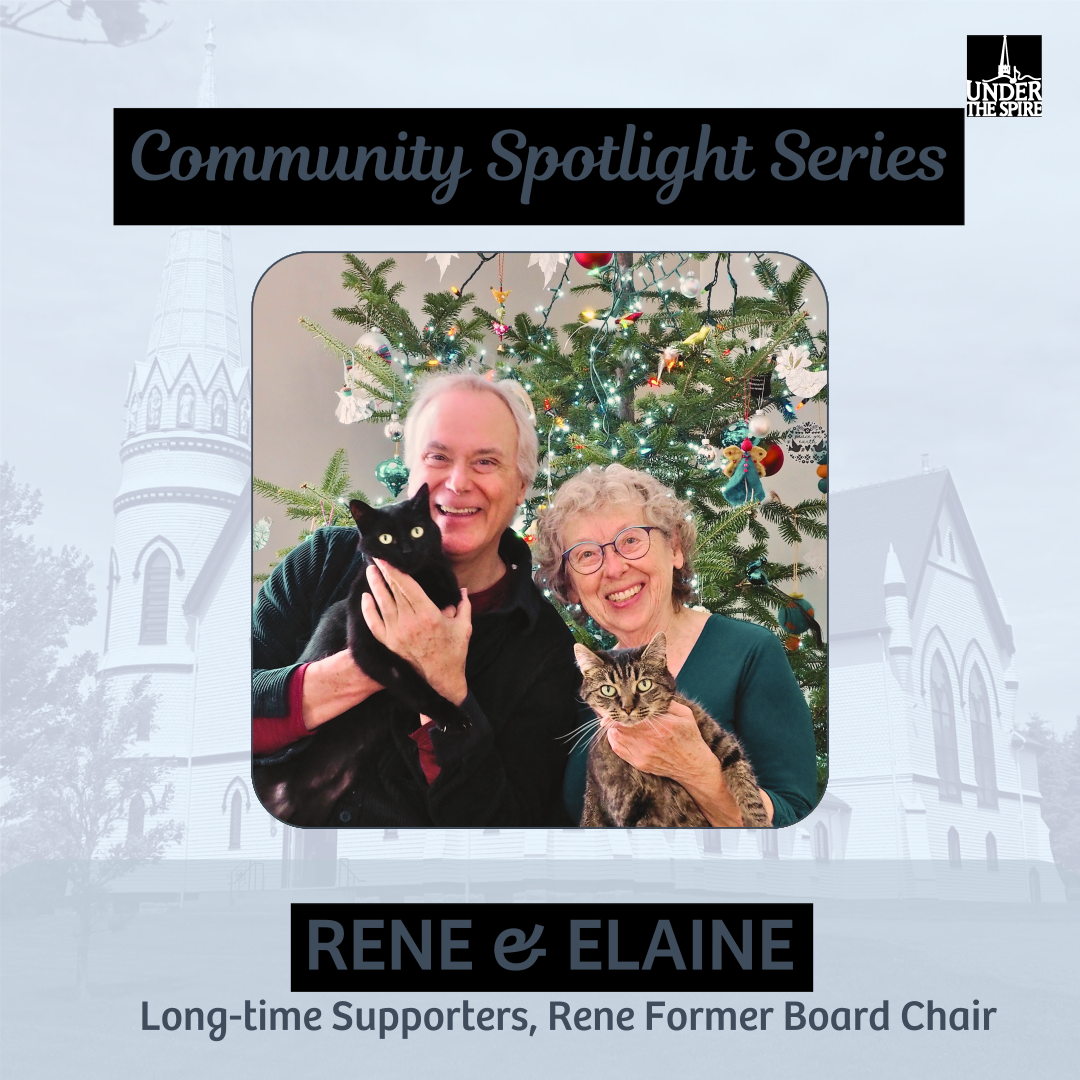
Community Spotlight Series: Rene & Elaine
As we celebrate our 30th anniversary in 2025, we’re excited to reflect on the vibrant stories and community members who have helped shape Under the Spire’s story. Our Community Spotlight Series will feature a diverse group of supporters, sharing their personal connections, experiences, and favourite memories with us across 10 interviews. Through their testimonials, we’ll explore why Under the Spire holds a special place in their lives and in our community. We are deeply grateful to everyone who has contributed to this celebration by sharing their reflections with us!
Community Spotlight Series
Interview with Rene Hurtubise & Elaine Schuller
1. How did you come to know about UTS, and how did you begin volunteering your time with the organization?
Elaine: It’s Rene who got it going, actually. We were singing with the Summerside choir at the time, and the choir sang there. We just loved it – even though we were freezing cold, since it was around Christmas time. Before we even joined the choir we had gone to some Christmas concerts there and loved it – even though we had to wear boots, scarves, mitts and hats and everything the whole time, shivering. And then they would ring the church bell after the concert, it was just glorious, it was a perfect Christmas feeling.
Rene: And the decoration of the church, as well.
E: All of the front was decorated with a dozen or more trees to do the whole circle, or just at the back, and they were all decorated with tinsel. And it was so totally beautiful. It was a traditional storybook Christmas.
R: That was our first experience there, attending concerts of the Summerside choir and then singing with that same choir. There would be concerts in the summer – Sundays in the Summer – before it became established as the Indian River Festival in 1996. Then, once that was created, we started attending pretty much right away and I got involved on board.
E: It was Mary Pendergast (a founding organization member) who was trying to go around the kitchen table and get something organized – and Renee volunteered to help. That was the start.
R: We saw some beautiful concerts. We still have our list of our ten most favorite concerts that we have seen there.
E: And all the artists that stayed here with us during those times, in those early days – because there was no money to put them in hotels, so they would billet with people. We met some really fun people. It was just great.
R: They were busy summers. We went to every concert, we would billet artists, and in the early days there would be receptions after the concerts as well. It was a different time! There was not a lot of money, so everything was volunteer based. Things are much more professional now.
E: It was homemade, and that was part of the joy because there was such a connection. I mean, we saw people and met people and had people in our house that you would never normally get to meet when you go to a concert in a big city. Sometimes we would host the receptions – the one I remembered the best was a men’s choir from Vancouver. The whole choir came here, all the men. There must have been 40 people. They all came over, we had pizza, and they were all just wandering all over. Some of them went outside, and were just amazed because they could see stars in the night sky. And they were such a good choir, too!
R: Choral music in that church – vocal music as a whole – is always a joy. The acoustics are perfect for that, so it’s fun. And then every summer, you’re part of a community. You go there and you know everybody and you feel comfortable. It would become like any group of friends that you have. There’d be lots of summer residents that you’d see for the first time at the first concert because they were away for the winter.
Rene, could you touch more on how you became involved with the board, and how you were both helping out with the organization in general?
R: I was on the board when Mary was chair – it was a very small board. It grew slowly, and I became involved with a lot with programming with Robert Kortgaard, who was artistic director at the time. Eventually Mary ran in a political election around 2006, and had to step down from being chair. I became acting chair at that time, and then became chair for seven or eight years. Those days are behind me now, but we always say – anything that the organization needs, we’re more than willing to help.
E: I never got involved with the meeting part, ever. I’m not one for meetings. But, whenever there was stuff that needed to be done, like baking sweets for the Soupfest fundraiser and sewing all those darn pew cushions – I was always happy to help. I’ll tell you about the cushions. We took all kinds of fabric cottons, all of us – because there were a lot of us involved – and there were foam rectangles that were purchased to use as pew cushions, and then we sewed covers for all of them. There were at least 150. We didn’t have enough to cover every seat of every bench, but they used to be stacked on the back pews before the concert, and people would pick them up going to their seats. That was an interesting little experience, but again, it was fun, because everybody was involved and everybody worked together.
R: The other thing too, before the organization bought the church from the diocese – obviously we had to share it with the parish, and that was an adventure in itself. There was collaboration depending on who it was at the time and the parishioners or the priest – there was always bit of a dance around availability, making sure it’s ready for mass the next day, and that the furniture is back in place so there could be mass – and that furniture is moved out, so there could be concerts.
Were there masses being held there right up until Under the Spire bought the building?
R: Yes – up until it was decommissioned, in about 2010. I was chair of the board at the time when we bought the church. By creating the organization as a nonprofit, it allowed us to access government funding to renovate the building. We did some renovations – that’s already 15 years ago, now. It has since been painted again, and roofed. We also had the pavilion built, and getting the washrooms installed was a major change. Where the washrooms are located now, is what they called the smaller winter chapel.
E: Being involved with the concert series was such a huge part of our lives in those years. Rene would be working and volunteering with the board, meeting regularly, and then working on the programming all year round.
R: We would volunteer during the concerts, as well. I would MC most of the concerts. And when we had the pavilion, I was so happy to work at the bar – I liked to work at the bar. It was a dream, a live dream come true!
E: I was thinking about this from when Rene mentioned fixing the roof of the church. We first bought this house, our home, in 1992. At the time, we didn’t know anything about the church. We went up in the attic and there were boxes of shingles that had been taken from the original siding of St. Mary’s. The previous owners were parishioners there, and had worked a lot on fundraising for St. Mary’s. Part of the ‘Save St. Mary’s’ campaign was that you could buy an original shingle for $100. That was before us, but to come here and to be in a house where somebody was very actively involved with the building was pretty odd. There must be a kind of magic in this house that makes a connection.
R: It’s like volunteering with anything – I think we got more out of it than we gave.. and we gave a lot, so we got a lot. Beautiful music, beautiful community, a sense of pride because of the work you’ve done and the contributions you’ve made, and memories that last forever. All of that is worth a lot.
2. You mentioned that your first exposure to the building was whenever you were singing in the Summerside choir. Do either of have any previous experience in the arts community?
E: Him more than me – I was always in church choirs or in the university choir, but I let that drop for a long time after I finished university.
R: I have a little training in opera singing. I did opera courses out west with Pacifica Opera Victoria, and then when we moved here, did a lot of singing with Carl Matthis at the university and got involved with a few different productions. Any time the concert series would have a chorus, I’d get involved. It’s such a fun thing to sing in that church because you just sound better there than you would in any other place!
R: CBC was such a big part of the festival for the first 10-15 years, and the festival would not be where it is now without CBC and Adrian Hoffman. Adrian was the producer for CBC in Halifax. He would come every summer – maybe once, maybe twice, sometimes three times – to record concerts and broadcast them on a maritime-based radio show, but some of it would be picked up nationally. When somebody from away comes and looks at your venue and says “You’ve got something very unique here, there’s nothing like that in the maritimes.” And you kind of say, “Oh, okay” it validates a lot of things. He was a musician himself, and very picky with sound because they would rehearse a lot. They would record their dress rehearsals and concerts – it was him and Rob Snedden that would come for a week.
Then there was Midsummer Magic each August. They would arrive on Monday and there would be concerts Thursday, Friday, Saturday, and Sunday. Rehearsals for all of those concerts were recorded. We would go to the dress rehearsals and then to the concert as well. We did all those concerts twice, just because it was so interesting. Then, we would listen to them on the radio. And again, CBC in those days were recording concerts – they don’t anymore to the same degree. There were a lot of classical musicians that performed there at the time that were just starting their careers, and performing at St. Mary’s with broadcast coverage from CBC was the right fit for them. If we just had the church without the CBC recording, would they have come all the way and do all those dress rehearsals and stayed at somebody’s house for a week? Because it was a big commitment. CBC played an essential role in the development of the festival, without doubt. It helped financially and it helped with its notoriety. The time is different, because now music is everywhere and nobody is listening to the same thing at the same time.
3. How has your time at UTS influenced your views on the importance of arts and culture within the community?
E: Well, it’s important because we both feel there’s a need for classical music, especially here on the island. There’s lots of venues for young artists and experienced artists in the little community halls and places like that and traditional music, but there’s not too many places for young classical people to actually perform and have a chance. We’ve always felt that Under the Spire served a huge purpose in that. We’re just hoping that it can continue – we don’t have the size of audience that people have in other places to do.
R: In arts and culture, we’ve always been involved in getting more than we give, and we continue to go to concerts and things like that. It adds a lot to our life. It’s always museums, concerts, galleries, photography- you know, the arts are important. Arts are important in our life because it allows us to experience things that are beyond the walls of this house and the cats. For me, it is the role of the community and government to make sure that the arts and culture is well-funded, like CBC and things like that. So, I’m always more than happy to pay tax because I believe that the taxes should be invested in the things we need. In this day and age where health care, education, roads and everything is so important – the share of money for arts and culture is getting smaller and smaller. It’s sad because it’s what identifies and differentiates us from the rest of the world – the art we provide. You come back from Paris and they have the same challenges with health, education, cost of living, apartments, medical – it’s the same thing. But the presence of arts and culture is in your face. Yes, it’s the density of population that is bigger, but at the same time, there is an awareness much greater than we have in Canada.
E: And not of just that, but of architecture, of photography, dance, museums. Everything is just so aware. It builds a sense of community and pride in who you are, in the identity of the country. It’s not just because you have free health care that you have to be proud of your country. There’s so much more that’s as important. And Under the Spire is a part of it, it’s unique in the Maritimes – certainly on the island.
R: We always thought with the programming, that it has to be of quality – to make the building sound as good as possible. The building was created for music, so the music that we put there should showcase the beautiful acoustics. It has provided an experience that you get goosebumps and you’ll never find anywhere else, and that’s wonderful.
4. Can you share some special memories that you have from your time at UTS?
E: Top of the list – The Jive Kings and Misha Brueggergosman. I was up in the balcony, thinking “Oh my God, the building is going to fall down!” It was vibrating. It was beautiful, just amazing.
I also remember Darby, whenever he came to help. Darby was just a godsend to the festival in those early days because he lived in the house next door. He was an old farmer. He did so much for us. The first Soupfest, the soups were heated in his kitchen and brought across the lawn to the tent. He was always there if you needed him. If there needed to be repairs, he was there.
R: Darby was not a parishioner, but loved the building. He said “That’s the best neighbor I can have.” We would leave the door open of the church, and he would make sure it’s open in the morning and would close the church at night, so that people had access. Anything we needed, he was the best neighbor possible.
R: You also had the cows across – that was the magic. The field across the church was always cows – never potatoes, so there were always animals that would come – animals are curious. When there was music or a lot of cars, the cows would come over and listen.
E: One of the first photos for advertising the concerts were brass players over in the cow field!
E: I also remember the time the power went out during the concert. There was a quartet playing. The power went out and they finished a concert totally acoustic by candlelight. It was just beautiful. They were much better than all the plugged in stuff. I also had a shivery feeling every time Matt Anderson had a concert there. Every concert, for his last song, he unplugged and sang in the middle of the room and then he would continue singing and walk down the aisle. I mean, it was just teary and shivery. There’s a lot of beautiful memories.
5. Drawing from your own experiences, do you believe that people should take interest in supporting live music and music initiatives within their communities?
E: It gives ownership, so I think it’s important. When you feel you own something, it’s yours. So then you’re just such a part of it. I think ownership drives a lot of people to get it involved. You have a say, you’re involved and you have a responsibility.
R: I mean, it’s the same thing as being a member of anything. Whether you’re a member of a congregation, a member of a staff team, or a member of a hockey team – it is yours and that’s where you make connections that will go way beyond work or a hockey team. You develop friendships when you go to this group. There’s something for them where they can connect and see their friends. We have a sense of community here with the neighborhood, a community of friends, but also a community of people like at Under the Spire, where some people became friends. Some people you always see three, four times a year and that can be the volunteers. So volunteers need that, you need to get something out of it, so they need to be appreciated. And they feel that they’re appreciated and they’re doing something that’s worth it, then they’ll be back.
6. What would you say to someone who has never been to a concert at UTS before, or who may feel a little bit nervous about exploring a new genre of music?
E: Well it’s magical. If you haven’t been, you don’t get it. If you can get them in there once for anything, there usually is usually a good chance that they might come back for something else. So having those kinds of diverse concerts, it’s a good thing because there’s a good chance you might increase your audience.
We hope you enjoyed reading Rene and Elaine’s interview! Be sure to read the rest of the interviews in this series